For US Healthcare Professionals
I am a
Crohn’s Disease Specialist



FOR THE TREATMENT OF ADULT
PATIENTS WITH
MODERATELY TO
SEVERELY ACTIVE CROHN’S DISEASE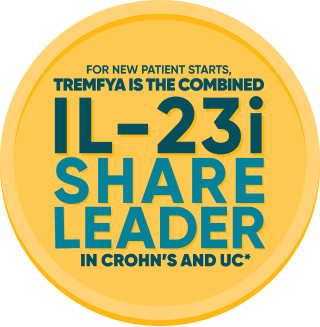 TREMFYA has an established safety profile across pivotal clinical trials in Crohn’s disease1,2
*This is based on information licensed from NPA/DDD
with business rules
applied and captures only
approved induction doses of IL-23 inhibitors for
adults with moderately to severely active Crohn’s
disease or ulcerative
colitis. Data used to support
this are from 2/21/2026 - 3/27/2026.

TREMFYA is backed by rigorous clinical programs and experience1-3

15+ years
of combined clinical research†
4
indications
including plaque psoriasis, psoriatic arthritis, Crohn’s disease, and ulcerative colitis (UC)‡

>1300
patients assessed in Crohn’s disease
†Based on a clinical trial of TREMFYA initiated in 2009.
‡Approved for moderate to severe plaque psoriasis, active psoriatic arthritis, moderately to severely active ulcerative colitis, and moderately to severely active Crohn’s disease.
DDD=Drug Distribution Data; IL-23=interleukin 23;
IL-23i=interleukin-23 inhibitor; NPA=National Prescription Audit.
Adverse Reactions (GRAVITI)
Most common adverse reactions occurring in ≥3% of patients through Week 48 in GRAVITI1
Column header | TREMFYA400 mg SC q4w 100 mg SC q8w* | TREMFYA400 mg SC q4w 200 mg SC q4w† | PlaceboN=117, | Column header |
| Respiratory tract infections‡ | 44 (38.3) | 35 (30.4) | 30 (25.6) | |
| Abdominal pain§ | 14 (12.2) | 16 (13.9) | 8 (6.8) | |
| Injection site reactions|| | 5 (4.3) | 4 (3.5) | 0 | |
| Fatigue | 3 (2.6) | 4 (3.5) | 0 | |
| Headache¶ | 7 (6.1) | 9 (7.8) | 5 (4.3) | |
| Arthralgia | 6 (5.2) | 5 (4.3) | 4 (3.4) | |
| Diarrhea | 6 (5.2) | 4 (3.5) | 3 (2.6) | |
| Gastroenteritis | 4 (3.5) | 2 (1.7) | 1 (0.9) |
Column header | TREMFYA®400 mg SC q4w | TREMFYA®400 mg SC q4w | PlaceboN=117, |
| Respiratory tract infections‡ | 44 (38.3) | 35 (30.4) | 30 (25.6) |
| Abdominal pain§ | 14 (12.2) | 16 (13.9) | 8 (6.8) |
| Injection site reactions|| | 5 (4.3) | 4 (3.5) | 0 |
| Fatigue | 3 (2.6) | 4 (3.5) | 0 |
| Headache¶ | 7 (6.1) | 9 (7.8) | 5 (4.3) |
| Arthralgia | 6 (5.2) | 5 (4.3) | 4 (3.4) |
| Diarrhea | 6 (5.2) | 4 (3.5) | 3 (2.6) |
| Gastroenteritis | 4 (3.5) | 2 (1.7) | 1 (0.9) |
Most common adverse reactions occurring in ≥3% of patients in GALAXI 2 & 3:
Through Week 12 in GALAXI 1,# 2, and 3, headache (including headache, migraine, and sinus headache) was reported in ≥3% of subjects treated with intravenous TREMFYA and at a greater rate than placebo (3.4% TREMFYA-treated subjects vs 1.9% placebo-treated subjects)1
*TREMFYA 400 mg as a subcutaneous injection at Weeks 0, 4, and 8, followed by TREMFYA 100 mg as a subcutaneous injection at Week 16 and every 8 weeks thereafter.
†TREMFYA 400 mg as a subcutaneous injection at Weeks 0, 4, and 8, followed by TREMFYA 200 mg as a subcutaneous injection at Week 12 and every 4 weeks thereafter.
‡Respiratory tract infections include bronchitis, COVID-19, H1N1 influenza, influenza, influenza-like illness, nasopharyngitis, pneumonia, respiratory tract infection, tonsillitis, upper respiratory tract infection, and viral upper respiratory tract infection.
§Abdominal pain includes abdominal pain, abdominal pain lower, and abdominal pain upper.
||Injection site reactions includes application site hypersensitivity, application site pruritus, injection site edema, injection site erythema, injection site hemorrhage, injection site mass, injection site rash, injection site reaction, and injection site swelling.
¶Headache includes headache and tension headache.
#GALAXI 1 was a randomized, double-blind, dose-ranging trial.
q4w=every 4 weeks; q8w=every 8 weeks; SC=subcutaneous.
GRAVITI SAFETY PROFILE FROM WEEK 0 TO 96 AND GALAXI SAFETY PROFILE FROM WEEK 0 TO 1442
Column header | TREMFYA400 mg SC | TREMFYA400 mg SC | Placebo‡(N=153) |
| Total patient-years of follow-up | PY=195.2 | PY=205.7 | PY=81.7 |
| Treatment-emergent AEs | E/100 PY | E/100 PY | E/100 PY |
| Any AE | 266.4 | 278.6 | 375.6 |
| Serious AE | 16.4 | 9.2 | 31.8 |
| AE leading to discontinuation of study agent | 5.1 | 1.5 | 12.2 |
| Infection¶ | 81.0 | 70.0 | 73.4 |
| Serious infection¶ | 1.0 | 0.5 | 0.0 |
| Deaths | 0.5# | 0.0 | 0.0 |
| Adverse events of interest | E/100 PY | E/100 PY | E/100 PY |
| Malignancy (excluding NMSC) | 0.51 | 0 | 0 |
| NMSC | 0.51 | 0 | 0 |
| Opportunistic infection | 0.5 | 1.0 | 1.2 |
| Tuberculosis | 0 | 0 | 0 |
| Hepatic disorders that were serious or led to treatment discontinuation | 0 | 0.5 | 0 |
Column header | TREMFYA200 mg IV | TREMFYA200 mg IV | STELARA~6 mg/kg | Placeboǁ(N=153) |
| Total patient-years of follow-up | PY=644.1 | PY=675.3 | PY=793.9 | PY=88.0 |
| Treatment-emergent AEs | E/100 PY | E/100 PY | E/100 PY | E/100 PY |
| Any AE | 274.2 | 288.3 | 264.9 | 422.8 |
| Serious AE | 11.6 | 9.8 | 12.7 | 27.3 |
| AE leading to discontinuation of study agent | 5.1 | 4.7 | 5.7 | 19.3 |
| Infection§ | 74.4 | 73.3 | 65.3 | 79.6 |
| Serious infection§ | 0.9 | 1.8 | 2.9 | 4.5 |
| Deaths | 0.0 | 0.0 | 0.1** | 0.0 |
| Adverse events of interest | E/100 PY | E/100 PY | E/100 PY | E/100 PY |
| Malignancy (excluding NMSC) | 0.2 | 0.1 | 0.4 | 0 |
| NMSC | 0 | 0 | 0.1 | 0 |
| Opportunistic infection | 0.2 | 0.9 | 0.1 | 2.3 |
| Tuberculosis | 0.2 | 0.1 | 0 | 0 |
| Hepatic disorders that were serious or led to treatment discontinuation | 0.5 | 0.7 | 0 | 0 |
GRAVITI SC Induction Study: Data through Week 96*
GALAXI IV Induction Studies: Data through Week 144*†
Column header | TREMFYA400 mg SC | TREMFYA400 mg SC | Placebo‡(N=117) | TREMFYA200 mg IV | TREMFYA200 mg IV | STELARA~6 mg/kg IV→ | Placeboǁ(N=153) | Column header |
| Total patient-years of follow-up | PY=195.2 | PY=205.7 | PY=81.7 | PY=644.1 | PY=675.3 | PY=793.9 | PY=88.0 | |
| Treatment-emergent AEs | E/100 PY | E/100 PY | E/100 PY | E/100 PY | E/100 PY | E/100 PY | E/100 PY | |
| Any AE | 266.4 | 278.6 | 375.6 | 274.2 | 288.3 | 264.9 | 422.8 | |
| Serious AE | 16.4 | 9.2 | 31.8 | 11.6 | 9.8 | 12.7 | 27.3 | |
| AE leading to discontinuation of study agent | 5.1 | 1.5 | 12.2 | 5.1 | 4.7 | 5.7 | 19.3 | |
| Infection¶ | 81.0 | 70.0 | 73.4 | 74.4 | 73.3 | 65.3 | 79.6 | |
| Serious infection¶ | 1.0 | 0.5 | 0.0 | 0.9 | 1.8 | 2.9 | 4.5 | |
| Deaths | 0.5# | 0.0 | 0.0 | 0.0 | 0.0 | 0.0 | 0.1** | |
| Adverse events of interest | E/100 PY | E/100 PY | E/100 PY | E/100 PY | E/100 PY | E/100 PY | E/100 PY | |
| Malignancy (excluding NMSC) | 0.51 | 0 | 0 | 0.2 | 0.1 | 0.4 | 0 | |
| NMSC | 0.51 | 0 | 0 | 0 | 0 | 0.1 | 0 | |
| Opportunistic infection | 0.5 | 1.0 | 1.2 | 0.2 | 0.9 | 0.1 | 2.3 | |
| Tuberculosis | 0 | 0 | 0 | 0.2 | 0.1 | 0 | 0 | |
| Hepatic disorders that were serious or led to treatment discontinuation | 0 | 0.5 | 0 | 0.5 | 0.7 | 0 | 0 |
In GALAXI, 27 patients who did not meet SES-CD criteria were removed from the primary efficacy analysis but were included in the all-treated safety set. The STELARA column includes subjects randomized to STELARA and events from placebo subjects after crossing over to STELARA at Week 12 up to dose adjustment.
*Week 96 was defined as 2 years. Week 144 was defined as 3 years.
†Includes events for subjects who dose adjusted up to the timepoint of dose adjustment, and all events through Week 144 for subjects who never dose adjusted.
‡Includes all placebo subjects excluding data after a subject is rescued with guselkumab.
§The STELARA group includes patients randomized to STELARA and events from placebo subjects after crossing over to STELARA at Week 12 up to dose adjustment.
||The placebo group contains all events for the randomized placebo group through Week 12. After Week 12, only the events from subjects who remained on placebo are included.
¶Infections are based on MedDRA system organ class Infections and Infestations.
#Reported through Week 12. Non-suicidal gunshot wound considered by investigator to be not related to study intervention.
**Reported through Week 144. Coronary artery arteriosclerosis considered by investigator to be not related to study intervention.
AE=adverse event; E=events; IV=intravenous; MedDRA=Medical Dictionary for Regulatory Activities; NMSC=nonmelanoma skin cancer; PY=patient-year; SC=subcutaneous; SES-CD=Simple Endoscopic Score for Crohn’s Disease.




Schedule a meeting with a local representative or an APP specialist
from Johnson & Johnson
APP=advanced practice provider.
References: 1. TREMFYA [Prescribing Information]. Horsham, PA: Janssen Biotech, Inc. 2. Data on file. Janssen Biotech, Inc. 3. ClinicalTrials.gov. A study of the safety and how the body affects a drug (CNTO 1959) in healthy volunteers and in patients with psoriasis. Accessed July 30, 2025.